Professional work
Research prototypeRadar-to-Video Calibration
A 3D workspace and camera-calibration pipeline for projecting radar trajectories onto recorded video.
Application & calibration workflow development
Computer vision integration / 3D geometry / Video tooling
Reusable camera profiles
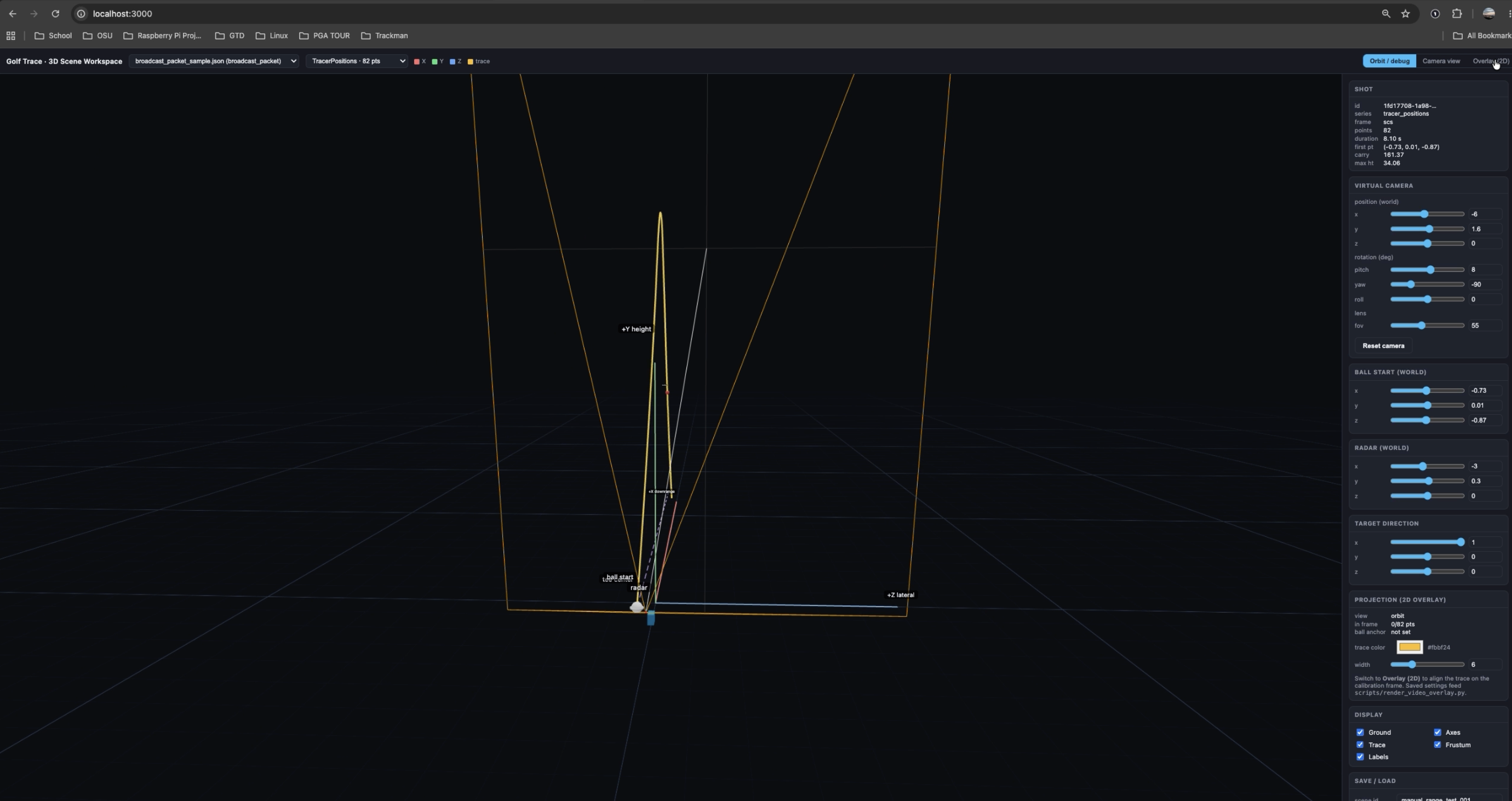
Interactive 3D alignment
Projected trajectory overlays
Built with
 Python
 OpenCV
 React
 FastAPI
 Blender
Context
Radar trajectories and camera footage describe the same event in different coordinate systems. Aligning them requires a camera model, a pose and a consistent treatment of the original trajectory.
This prototype worked with recorded footage. The work continues live, on a phone, in AR Tracing Studio.
What I built
- Trajectory adapters: normalize source messages into a common shot representation.
- Calibration workflow: reusable camera profiles, lens-distortion parameters and ChArUco-based intrinsic calibration.
- 3D workspace: inspect the radar, ball start, virtual camera and projected trace together.
- Rendering path: project the trajectory into image coordinates and export a video overlay.
Design decisions
Calibration is saved as data rather than left inside an editing session. Camera intrinsics, pose and scene configuration can be reused by the viewer and renderer, which makes experiments easier to compare.
The work integrates OpenCV and existing radar data; it does not replace their underlying algorithms. Visual alignment is useful for development, while projection accuracy still needs explicit validation.
Project overview
The prototype combines a Python projection/rendering layer with FastAPI and a React Three Fiber workspace. Related Blender experiments explore the same geometry through a separate scene workflow.
My committed application baseline covers the calibration, projection and web experience. Later desktop-launcher work extends the local workflow. The emphasis is repeatable experimentation: preserve the camera model, inspect how a 3D flight maps into pixels, and review the rendered result.